


In New York City, Local Law 11, aka the Facade Inspection & Safety Program (FISP) requires that all buildings over six stories tall undergo a facade inspection every five years. Cycle 10 commenced on February 21, 2025, and will run through February 21, 2030.
FISP’s origins date back to a deadly event in 1979 when a loose piece of masonry fell from a building facade on Broadway and 115th Street and killed a 17-year-old girl passing below. The tragedy led to the implementation of Local Law 10 in 1980, which required buildings taller than six stories to have street-facing facades inspected every five years for unsafe conditions. LL10 was amended in 1998 to become Local Law 11, mandating that all facades—not just those facing the street—be inspected by a certified engineer or architect.
The Inspection Process
Inspecting a six-plus story building is a group project that includes engineers, building staff, board members, and city agencies. “It can look like a slow process, but if the client is engaged and needs to complete the project, it will get done,” says Alexei Tajzler, Director of Building Envelope for engineering consulting firm, The Falcon Group, with offices all over the United States, including New York, New Jersey, New England, and Florida. .
Among these players is the Qualified Exterior Wall Inspector (QEWI) who assesses the building and files a report with the Department of Buildings (DOB). In reality, the QEWI’s report is actually three: the first is the initial inspection, which is effectively made from street level, nearby rooftops, balconies, terraces, and pretty much anywhere the inspector can walk to, including backyards and courtyards.
“We try to get on rooftops of neighboring properties and that kind of gives us an overall understanding of the facade and its current condition,” says Tajzler. “In addition, we have to look at the previous report from the previous cycle as well, because if there's anything that's in those previous reports that hasn't been repaired, we have to confirm either way: has it been repaired, or is it still present in the building?” Inspectors also carefully assess side and rearward-facing facades. “Everyone spends so much time paying attention to the street facades that the ones on the other sides tend to get ignored,” says Tajzler.
What They’re Looking For
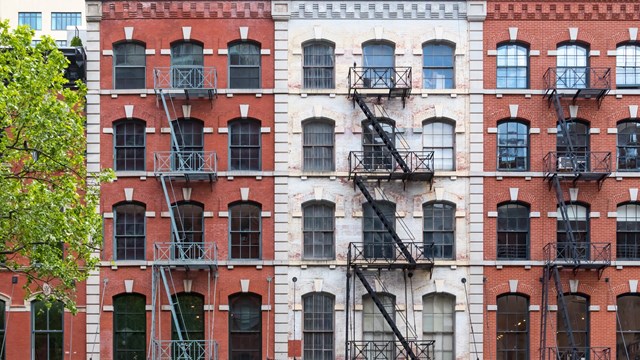
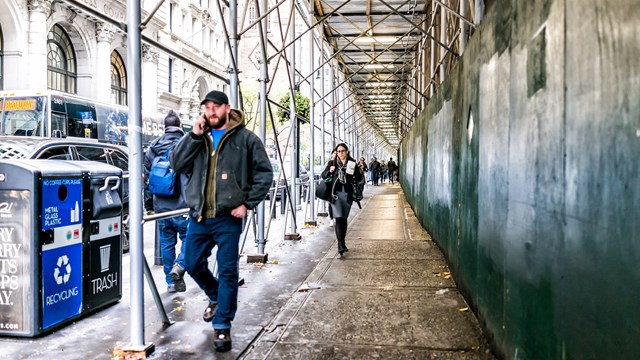
According to Dan Wollman, CEO at NYC property management company Gumley Haft, when inspectors assess a building, they’re looking for displaced, cracked, or broken masonry like limestone and terracotta bricks, deflection in lintel steel (the strip of steel on the top edge of windows), and brickwork above the lintels, as well as rust and any other significant cracks or gaps. “You don’t need a shed or scaffolding for the inspection process,” he says, “but you have to protect within 20 feet of the work area, so if you’re doing anything on the outside envelope of the building, you need to have a sidewalk bridge erected.”
According to Tajzler, the most common current facade issues are with terra cotta. “Most of the terracotta is approaching 100 years in terms of life cycle, and we have some very ornate buildings that have quite a lot of individual terra cotta elements,” he says, “so what ends up happening is you check the building and identify 20 bad pieces and you fix those 20 pieces, and then you come back the next cycle, and now it's 40 pieces, and then you fix those. It’s almost always on a report.” Tajzler notes that the New York Department of Buildings is hypersensitive to terra cotta (the infamous 1979 fatality mentioned at the beginning of this article involved a piece of terra cotta) and takes a conservative stance on the building material.
After terra cotta, metal window lintels are next on the list of materials most vulnerable to deterioration. Many were not properly waterproofed when they were installed, and as a result have rusted. “And once they rust, they expand,” says Tajzler. “Expanded steel pushes against the brick, causing cracks—and the only real way to fix that is to take the brick out and redo the steel.” Nowadays, curtain walls and pre-cast panels have a silicone sealant at connection points that preserve waterproofing so long as they are maintained. “In theory, it keeps the water out, as opposed to a brick or stone facade, where every mortar joint is a porous entry point,” he adds.
Next Steps
After inspections are complete, a building is classified as Safe, Unsafe, or Safe with a Repair and Maintenance Program (SWARMP). Conditions identified as Unsafe must be corrected immediately. Conditions identified as Safe with a Repair and Maintenance Program (SWARMP) must be corrected prior to the repair date recommended in the FISP report, but no later than the filing deadline of the following inspection cycle.
Based on the engineer’s report, an architect typically details all of the needed repairs, and the board can then work with its team of professionals to develop a plan of action to make those repairs in the allotted time.
Working with managing agents, architects, and engineers helps everyone get on the same page from the get-go. “Staging and mobilizing these projects is one of the most expensive parts, meaning bridging, scaffolding, permitting, etc,” says Wollman, “you want to try to think ahead and make sure your professionals are setting your expectations at the right place given the age and condition of the building.” Bad news is never easy to hear, but having realistic expectations can save everyone from headaches down the line.
The Long Haul
Due to the process and documentation required, not to mention the physical work itself, facade projects are notoriously slow going. In addition to the initial inspections, engineers may have to perform additional evaluations and testing. After that, engineering reports and FISP filings, DOB filings, permits, potential landmarks department approvals, contract negotiations, access agreements with neighboring properties, and financing constraints are all at issue. “Each step requires legal input,” says Attorney Marc Schneider of the New York law firm Schneider Buchel. “Ultimately, contractor(s) need to be hired, and attorneys are likewise needed for review and drafting of documents to ensure compliance and reduce liability. This all takes time to be completed properly, and oftentimes involves some negotiation of many of the requisite documents involved in the process.”
Daunting as that may sound, procrastinating with all this bureaucracy can cost you, Schneider continues. Failure to timely correct an Unsafe condition can result in DOB violations, including “the imposition of significant monetary penalties, and civil liability, including liability exposure if an incident occurs. In addition, DOB penalties for Unsafe conditions may continue to accrue until the condition is corrected and required amended reports are filed.”
Talking Money
While no reasonable person would argue against keeping buildings and people safe, boards have some very understandable concerns about the cost of compliance with LL11. In the past, if buildings had adequate reserve funds, they could usually cover the cost of mid-to-large-scale facade work without resorting to heavy assessments or loans, but nowadays that’s not the case. Few buildings can take a $750,000 or even $1 million financial hit, but that’s exactly what some are facing.
“Before, buildings could borrow at around 3% interest, and smart buildings were taking advantage of the economic opportunity to fund their reserves so they didn’t have to borrow when rates were at 5% or 6%,” says Wollman. “A lot of those were 10-year mortgages that are maturing, and banks are going to refinance those mortgages at closer to 6% in today’s market. “These usually end up going to a special assessment. It will be interesting to see how this works in this cycle.”
“Everyone would love these projects to be really finite,” says Wollman, “and the reality is that there are a lot of unknowns, especially in older buildings. You take your information and make the best decisions you can. I’m in the camp of wanting my client to have reasonable expectations in terms of cost and time.”
Kate Mattiace is associate editor of CooperatorNews.



Comments
Leave a Comment