


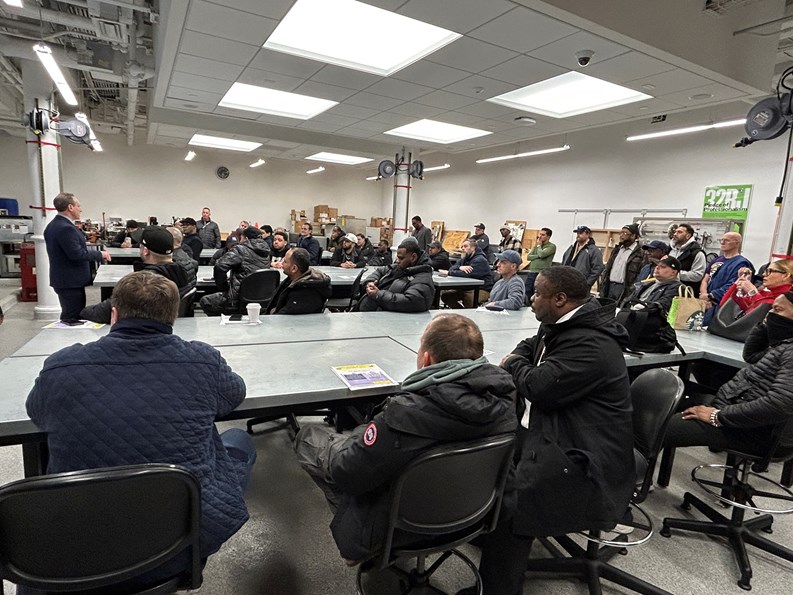
According to a March 26 press release from the Service Employees International Union 32BJ SEIU, the union has set April 15, 2026 as the date for a strike vote amidst contract negotiations with NYC’s Realty Advisory Board on Labor Relations (RAB). The current four-year labor agreement between 32BJ SEIU and the RAB covers around 34,000 NYC residential building workers servicing some 600,000 NYC households, and expires on April 20; on April 15, ahead of that expiry, the 32BJ doorpersons, porters, superintendents, handypersons and resident managers will rally on Park Ave and take a formal vote on whether to authorize a strike.
Among the union’s demands are safeguards for the comprehensive employer-paid family health care included in the current agreement; wage increases to catch up and keep pace with the cost of living and inflation; stronger pension benefits; protection of legal and training benefits; protections for immigrant members; improved work conditions, and paid leave.
Representing the owners and managers of large commercial and residential buildings, the RAB’s proposals include requiring employees to share in the cost of their healthcare premiums, and the creation of a “Tier II” classification for workers hired under the new labor agreement which would allow buildings to hire future employees under different (generally lower) wage and benefit terms than current union members.
Negotiations have been rocky in recent days; in the press release, 32BJ SEIU President Manny Pastreich described the RAB’s proposals as “disappointing and insulting,” noting that “We won’t let the thriving real estate industry raise health care costs, jeopardize retirement security, and undermine the core fabric of a labor contract that thousands of working families depend on. We call on New Yorkers to join us and stand with the essential residential workers who show up for our city every day.”
To that end, the union has mobilized 1,400 strike captains across the city to prepare for a possible strike. Last week, the union announced an additional 300 workers had signed on as Strike Captains ahead of this latest bargaining session.
On the other side of the table, RAB representatives have characterized negotiations as “serious but constructive,” while consistently underscoring cost pressures and the need for structural changes. According to a March 12 item in the Amsterdam News, in a recent statement on the talks, RAB president Howard Rothschild said that “We look forward to continued productive meetings that will result in a fair and mutually agreeable resolution for both sides. Over the next 42 days, the union and industry must come together to negotiate a contract that will provide for a sustainable future of the industry.”
If a Strike is Called
While contract negotiations between the union and the RAB have often turned contentious over the years, nearly all have been settled before a full walkout. The last full building workers strike was back in 1991, and lasted 11 days, significantly disrupting operations across co-ops and apartment buildings citywide.
32BJ SEIU members’ day-to-day duties include custodial tasks, clearing snow and ice, collecting and taking out trash, welcoming residents and guests, security, maintaining building heat, AC, electrical, sprinkler and other systems, painting and repairs, receiving and securing packages, as well as being called upon to respond to emergencies from power outages to medical crises. A strike would have immediate, highly visible impacts across the city’s residential co-ops and condos; along with the disruption of those everyday duties, amenities like gyms and pools may have to operate under reduced hours—or be closed outright—and moves and nonessential renovations could be halted entirely.
A strike would also shift many of those aforementioned responsibilities onto building management, boards, and residents, and a prolonged disruption could also increase costs as buildings turn to temporary staffing or private security to absorb operational inefficiencies. Those interim workers are typically engaged through a co-op or condo’s management company to cover essential roles like front desk security and basic cleaning, though often on a scaled-back, ‘bare-bones’ schedule.
As the negotiations continue, legal and management pros strongly encourage boards to keep residents informed so they can be prepared to deal with any inconveniences and temporary rules (restricted move-ins, stricter access control) their board and/or management may have to implement in the event of a strike to maintain safety and reduce the strain on limited staff.




2 Comments
Leave a Comment