


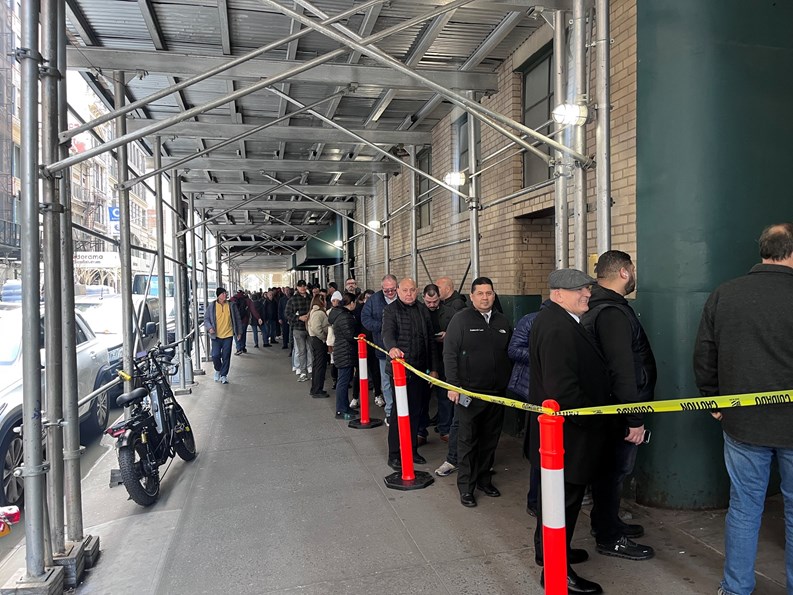
Contract negotiations began on March 5th between 32BJ SEIU—the labor union representing more than 34,000 doormen, porters, superintendents, and other building staff in the city—and the Realty Advisory Board on Labor Relations (RAB), representing the interests of co-ops, condos, and building owners across roughly 3,000–3,500 properties. The current four-year contract expires on April 20, 2026, creating a firm deadline for a new agreement.
Labor is also the single largest expense line item for many co-ops and condos, making these negotiations both familiar and consequential for both parties, hinging as they do on issues around wages, healthcare, pensions, and working conditions. The union is pushing for fair wage increases tied to inflation, the preservation of fully employer-paid healthcare and pensions, stronger retirement benefits, and expanded paid leave. On the other side of the table, building owners are focused on maintaining financial stability in the face of steeply rising operating costs.
According to early reports from the New York Amsterdam News, and the New York City Central Labor Council (NYCCLC) the talks are “off to a cordial start,” with the tone of negotiations thus far being measured rather than adversarial. That said, as is typical of high-stakes labor negotiations in the city, the union is pairing cooperative talks with visible strike preparation, training over 1,000 strike captains and signaling readiness to walk out if necessary.
The Impact for Co-ops & Condos
Residential buildings depend heavily on union labor for daily functions like security, cleaning, maintenance, and package handling, so these talks should be of keen interest to boards and residents alike. An increase in wages or benefits for building staff will directly impact operating budgets, and could potentially lead to higher maintenance fees or common charges. Buildings already grappling with insurance premium increases, Local Law compliance costs, and inflation may face difficult financial trade-offs. On the other hand, according to the Bureau of Labor Statistics, the cost of living in NYC has increased by around 25% since the last time the union contract was renewed, while wages for workers have remained stagnant—putting financial strain on the people who keep buildings running smoothly from day to day.
If a strike were to occur, it would of course have a major operational impact on the city’s multifamily communities. A walkout would force buildings to rely on temporary workers or management staff to carry out day-to-day maintenance and support functions—often less efficiently, and at a higher cost. Service and maintenance disruptions could quickly affect resident satisfaction, and eventually even impact property values.
That said, the odds of a strike are not high. Historically, while agreements are often reached close to deadline, sometimes after intense last-minute negotiations, the union and the RAB have a decades-long bargaining relationship, and typically engage with each other in good faith. Indeed, NYC has only experienced one citywide residential building worker strike in the last 50 years, back in 1991.
So while the stakes are definitely high, the current negotiations appear to be following the usual four-year routine and progressing smoothly so far. For prudent boards and managers, the best approach is to stay abreast of the process, reviewing contingency plans, stress-testing budgets, and closely monitoring developments as the April deadline approaches.




Leave a Comment