


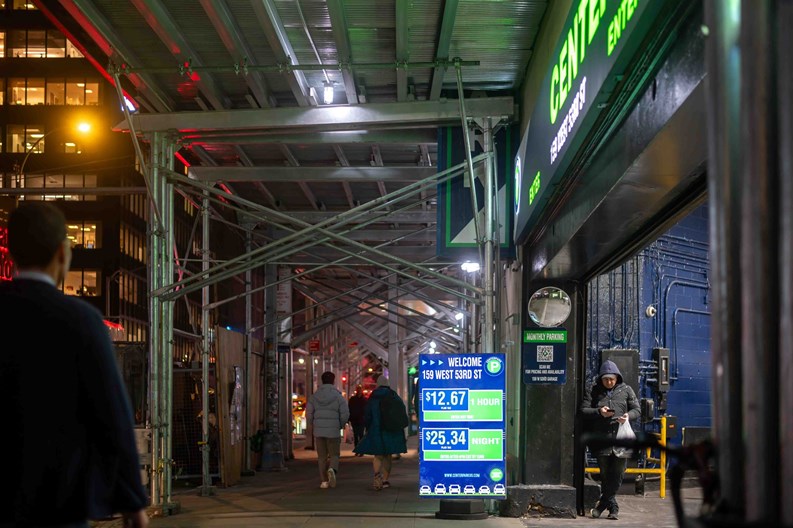
Sidewalk sheds are a frequent sight—and frequently a point of contention—across all five boroughs. Put up to facilitate facade inspections and repairs, they often remain in place for months (or even years), accumulating trash and other debris, darkening the sidewalk below, and quickly becoming an eyesore.
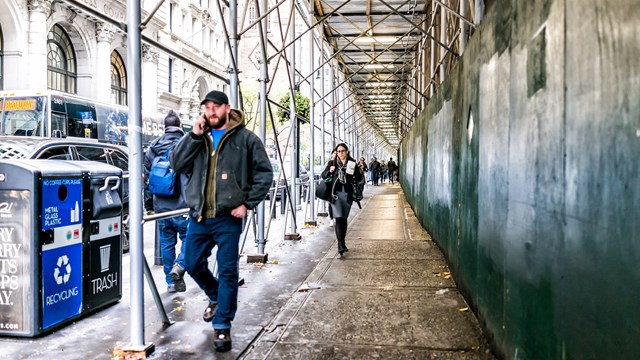
"Support scaffolding, also called pipe scaffolding, often features stair towers, and is designed for workers to walk up and down,” says Alexei Tajzler, Director of Building Envelope for engineering consulting firm The Falcon Group. “In contrast, a sidewalk shed is the structure at the very first level, sitting directly on the sidewalk. They’re usually green, range from eight to 16 feet tall, and are installed regardless of the type of scaffolding used above.”
A shed’s main purpose is to protect the public below from anything that could fall from above, such as construction debris, tools, or building materials. This is of course a very good thing, but as mentioned above, sheds also throw the sidewalk into shadow, create blind corners and puddles of standing water, and tend to accumulate garbage, which in turn attracts rats and other pests.
Get Sheds Down
To address this safety and quality of life issue, the Get Sheds Down mayoral initiative was launched by former mayor Eric Adams in 2023. The primary target of the initiative was to reduce the amount of time sheds can stay up—not at active construction sites, but sites where little work was happening, either because of contractor delays or because building owners or boards were stalling.
The initiative has several components. Legislation signed in 2025 establishes new penalties to compel property owners to complete repairs more quickly, reduces the duration of sidewalk shed permits, increases the frequency of facade inspection requirements, and expands lighting requirements for sheds that do go up. New enforcement measures took effect in early 2026.
Since the initiative launched, the City says it has removed more than 15,200 sheds—including 429 long-standing structures that had been up for five years or more. In March of 2026, Mayor Mamdani addressed the issue while speaking at Highbridge Gardens in the Bronx, a New York City Housing Authority (NYCHA) site with 4,100 linear feet of sheds that have been in place for almost five years.
“Citywide, sidewalk sheds cover 380 miles, or 7,500 city blocks, thanks to obscure and outdated regulations that make it easier to leave a building in disrepair than to fix the issues that are actually at hand,” Mamdani stated. “Some have lingered over our streets for more than 15 years. As a result, New Yorkers have come to expect darkened sidewalks as just another frustration endemic to New York City. This is an issue that extends beyond the structures themselves.”
The Drawbacks
While many residents may welcome the removal of blocks of hulking pipe-and-plywood sheds, boards and their contractors are navigating a compounded challenge: in addition to the complex, costly process of facade inspection and repair, they must now contend with the added pressure of potential fines and legal penalties if progress stalls or permits lapse.
“Unless you can miraculously replace buildings with new materials that don't fall apart, or you can speed up the bureaucratic process of the DOB or LBC, or have control over the weather, there is no magic bullet to avoiding sidewalk sheds,” says Tajzler. “For typical buildings, you’re working outside with sensitive materials, so you can really only work from March 15 to December 15. Once the temperatures get too low, or too windy, or too rainy, you can’t effectively use those products, so you’re very limited by these windows of time.”
“The Get Sheds Down initiative resulted in increased cost as the permit period was reduced and renewals now require proof of ongoing work,” says Attorney Marc Schneider of the New York law firm Schneider Buchel, “At the end of the day, the sheds are necessary if the work is ongoing. The process to keep them there just became more involved, and subject to greater oversight—and there are more proposed changes coming. ”
“There is no fixed legal deadline requiring sheds to come down if unsafe conditions remain,” Schneider adds. “However, once the condition is corrected, there is a clear regulatory expectation that protective measures like sidewalk sheds be removed without unnecessary delay, as structures are intended to be temporary and only justified by an ongoing safety need.”
Keeping a shed up longer than needed can raise questions or potential enforcement if the shed remains in place without a continuing hazardous condition or ongoing work justifying its presence. In the long run, it isn’t in anyone’s best interest to prolong a project or keep costly, unsightly, ineffective sheds up unnecessarily.



Comments
Leave a Comment