


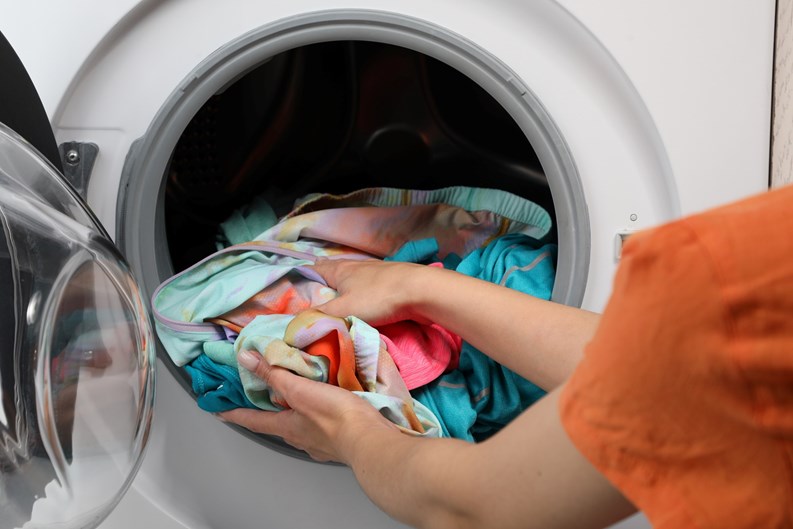
Having an in-house laundry facility is more than just an appealing amenity in multifamily communities—the ability to get this fundamental chore done without leaving their building offers residents accessibility, safety, and comfort. After lobbies, laundry rooms are also arguably the most frequently used shared spaces in a residential building.
Advances in laundry technology—including apps, cashless payment systems, and high-efficiency machines—have made laundry rooms more attractive and user-friendly to residents who rely on them. We’ve come a long way from bleak basement laundry rooms with a couple of ancient coin-operated machines and a flickering fluorescent bulb overhead, but it still takes regular maintenance, housekeeping, and care to keep even the sleekest laundry facility functioning efficiently.
So Fresh, So Clean
The pandemic highlighted the critical importance of paying close attention to hygiene and cleanliness, especially in communal areas. Denise Savino-Erichsen, president of Automatic Industries, a multi-housing laundry equipment and service provider based in Hempstead, New York, says it was an ‘awakening’. “Health and hygiene were always important, but post-pandemic, it became heightened,” she notes. Even at the height of the lockdowns, “You absolutely had to be able to launder your clothing. [That’s why] it’s so important that things are kept clean and machines are wiped down. People are more aware of this than ever now.”
In response to this increased awareness, Savino-Erichsen says that equipment manufacturers are continuing to develop stricter sanitation protocols and upgrades to their commercial washers and dryers, including manufacturing gaskets from antimicrobial materials and using disinfecting tablets.
It’s important to promote routine cleaning to reduce issues with machines, such as wiping out soap trays and gaskets before or after each use. “We try to train supers when we start any job, and usually give them a laundry credit so they can periodically flush out the machines,” says Ted Mottola, VP of Strategy & Finance for Tedimatts Laundry Services. “While we are a vendor, it’s truly a partnership. Vendors can’t be on-site after each load.”
Regular inspections also help keep laundry rooms in compliance with city codes. For example, a provider in New York will make sure gas dryers are connected with a rigid pipe to comply with the NYC DOB code. “If the room is not in compliance, we make sure the customer is aware,” says Colas. Communication is a critical component of relaying information, providing recommendations, and making improvements as needed during the installation process.
Keeping the laundry area clean and hygienic includes more than just machine oversight, however—it means paying attention to the entire space. “The laundry room needs to be ‘up to snuff,’” Savino-Erichsen continues. “Nobody wants to be brought down to a dingy laundry room. We can’t always pick the location of the room, but we can make sure it’s well-lit and freshened up so it reflects the equipment. Residents and building owners want the room to look exceptional.” This might include a fresh coat of paint in a light color to brighten the space, wall decor, comfortable seating, clean, uncluttered surfaces for sorting and folding, and ample waste receptacles for lint and other debris. For buildings with the space and budget, vending machines and other amenities may be an attractive option as well.
Advanced Operations—No Coins Required
In addition to updated cleaning protocols, laundry rooms have also modernized their payment options. Traditional coin-operated machines are being replaced with more technologically advanced options. Elijah Colas, marketing and sales representative for laundry provider Hercules, which serves New York, Pennsylvania, New Jersey, Connecticut, Delaware, and Massachusetts, notes that many companies now offer mobile payment options, allowing residents to pay via app—no quarters required. “Recent studies show 85% of residents prefer cashless solutions,” he says, “and most residents prefer cashless payments, which eliminates the hassle of handling coins. Card and app-based systems make laundry more accessible and convenient, along with options for credit card and cash payments.”
Savino-Erichsen agrees, emphasizing that coin-operated machines have been phased out, particularly in the New York metro. “That’s 15- to 20-year-old technology,” says, “Now, depending on a building’s demographic, you have laundry cards or mobile apps.”
Doing laundry isn’t anybody’s idea of fun, but in addition to streamlining payment, technology also enables features that improve the overall resident experience, says Mottola. “There’s a lot more connectivity of machines, which is something that’s being asked for more and more,” he notes. “You have the machines hooked up to a monitoring system so residents can see which ones are available to use before they lug everything down to a laundry room. Residents can also get reminders when their load cycle is almost complete. On the payment side, people can pay with cards or on their phones.”
Understanding your building’s demographic is key to making sure your laundry facility serves everybody in the community. “You have to know your audience,” says Savino-Erichsen. “If you have an older demographic, they don’t necessarily all want to pay with their smartphone, so it’s important to know your building. You can use a mix of apps and cards.”
New technology also benefits building owners and property managers. Remote monitoring enables staff to identify maintenance needs and view usage statistics, often via simple text alerts or notifications. Instant refunds can be issued at no extra cost to residents, reducing service calls and improving resident satisfaction.
For all the improvements in the industry over the last couple of decades however, Savino-Erichsen cautions that technology cannot replace in-person oversight. “I’m a strong believer in the human component,” she says. “When you’re doing work in someone’s home, they expect a certain level of service. You can clear an error code over the phone or the computer, but you’re better off physically walking the room. You can’t see if there’s mold on the gasket, for example, if you don’t have eyes on everything. ”
Revenue Structures
Understanding how the building-vendor relationship works in the context of laundry services, and how revenue from your own building’s laundry room is collected and distributed is every bit as important as the physical room and equipment itself. Generally, vendors provide laundry carts, tables, paint, and signage. The vendor handles everything from the walls in, and the building is responsible for the walls out–utility hookups, so the water supply, the drains, the lighting, air, etc.
Savino-Erichsen says a typical setup is for larger laundry companies to own the equipment and provide the services. In this case, the provider is responsible for maintaining the equipment, carrying the necessary insurance, making repairs and replacements, and usually also taking care of the laundry space itself. “Most larger companies provide equipment, payment systems, and other services without any capital outlay to the building and, in most cases, the building will receive revenue, so it’s a win/win situation. They have an amenity, and they’re getting some money for the space.”
Revenue sharing is customized for each building. “Typically, we enter into an agreement where a portion of laundry revenue is paid back to the building, ensuring a mutually beneficial partnership,” says Colas. Revenue shares depend on many factors, including the cost per cycle, the number of machines, and improvements to the room. “We customize each proposal based on these factors and estimated use/revenue,” he adds.
“There are usually two approaches boards and property managers consider,” says Mottola. “Is this an amenity or a revenue driver? In terms of revenue and ownership, I’d say 85% of the time we own the machines and 15% of the time the building will own them. If a building owns the machines, it either pays for them outright or finances them. They charge whatever they want, and vendors provide set up. The building will keep its profits and pay a standard flat service fee. Alternatively, they can let us collect everything, and we charge for service and labor. I’d say most buildings aren’t interested in laying out the capital, which is why our industry exists. They’re not interested in dealing with the money and customer service.”
“Everything costs more right now with inflation,” he continues, “so we try to leave the decisions with the building on where they want to spend money. Sometimes, we’ll do a signing bonus, and that will allow managers to complete whatever projects are priorities, whether it’s a new sink, flooring, or something else for the area.”
Contract Options
A standard install assumes that all required electrical, venting, and plumbing is already in place. If a new laundry room is built from scratch, the building is responsible for providing the necessary infrastructure and utilities. Maintenance programs can cover repairs, preventive services, parts, and machine replacements. For full service or lease agreements, all repairs—even out-of-warranty—can be included at no extra cost.
As for what’s included in the typical installation process, Colas says it will likely start with a thorough site survey to ensure everything fits and functions as planned. “We coordinate closely with building management for scheduling and can provide cosmetic upgrades like painting or tiling if requested,” he says, “After installation, a supervisor inspects the room to confirm it’s fully operational.”
Colas says the best options are flexible contract options designed to fit every building’s needs. Many companies handle installation, ongoing service, and collections for washers, dryers, and payment technology. “For example, we install and service the equipment, while the building manages collections,” he notes. “With this option, the customer incurs no up-front or out-of-pocket costs for the equipment investment. You can also set machines to run for free as an amenity under this option.”
Board members are very busy, and laundry isn’t always their top priority. Mottola notes that “sometimes in trying to find the best financial package, they can miss some nuances. Everyone generally has to provide the same service, so why is there a cost discrepancy? It’s probably for one of two reasons: Either someone is offering you a cheaper product, which is fine as long as you’re aware of it, or there is something different in the frequency or availability of services. You want to have the conversation to get clarification because you’re often signing up for an eight-year ‘marriage’.”
Efficient Equipment
Sustainability and conservation are increasingly important considerations for laundry providers, as property managers and residents seek efficiency. “Water conservation is a big issue. Water and sewer charges are expensive, and people also want to see that things are being done on the building’s end to conserve the environment,” says Savino-Erichsen, noting that all current EnergyStar washers carry the energy efficiency label. “In new construction, that’s all they want to see, and most equipment meets those guidelines,” she says.
The amount of water used daily is often an overlooked factor. According to the NYC Department of Environmental Protection, a standard washer can use 45–55 gallons per load, while switching to an energy-efficient unit reduces consumption to 20–25 gallons per load. “Generally, front-load machines are a little bit more expensive, but they are energy-efficient,” says Mottola. “Top-loader machines are a little bit cheaper, so you’re probably going to get a bigger payout, but the hidden cost is that they’re not energy-efficient or as durable. In a top-loader, the whole drum needs to fill up with water to wash, whereas the front-loader only has to fill up halfway.”
“In our association, we are looking at water studies now that are showing that central laundry rooms save a lot more water than in apartment units,” says Savino-Erichsen. “When they’re inside individual units, people tend to do more loads of laundry and use more water.”
Tracking service calls with logs was helpful in the past, but a better indicator is checking the cycles. Mottola likens it to having an old car with very few miles on it. “You wouldn’t necessarily have to replace that car,” he says. “The same goes for laundry machines. If you have a washer that’s been around for 15 years but has only 5,000 cycles, it’s fine to keep running. It’s more about usage than age. From an environmental standpoint, [discarding working machines simply because they’re older] isn’t good, because machines end up in landfills. From a financial standpoint, if you’re having to buy new machines every eight years, you’re going to share less in profits, because you have to cover costs first. It’s better to be more strategic overall.”
From energy upgrades to mobile payment systems, laundry service has evolved to continue to meet the needs of buildings. “A laundry service is, in essence, a tenant of the building,” says Savino-Erichsen. For property managers, this means reliable equipment and operation with potential revenue options. For residents, it means daily convenience. When done right, laundry service is a win-win for everyone.”
Kate Mattiace is associate editor of CooperatorNews






Comments
Leave a Comment