


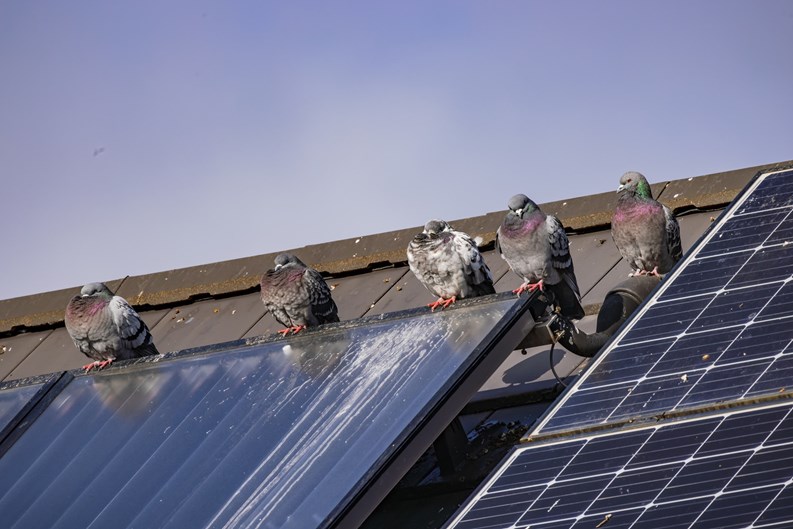
Cities are known for being home to diverse populations that thrive in fast-paced, crowded environments—and not all of those populations are human. The same dense landscape that attracts people also attracts bold, resourceful, and highly adaptable birds. New York City is home to hundreds of bird species, including cardinals, robins, sparrows, woodpeckers, and of course, pigeons.
In fact, the Manhattan pigeon population is estimated to be at least a million. That’s around one pigeon apiece for every eight residents of the borough. And while the ubiquitous bird has earned its place among iconic NYC mascots, its presence can lead to unsanitary conditions, health problems, and even structural damage, making it more of a nuisance than a joy for multifamily building residents. Let’s take a closer look at what buildings can do to mitigate and manage some of the more annoying side effects of these avian adversaries.
A Health Hazard
Like us, birds seek out food, comfort, and safety. They look for spots protected from wind and rain—a covered ledge on a sill, or inside an awning, for example. A representative for NYC-based pest control service Regal Exterminators notes that the areas of a building most susceptible to bird activity are places that make birds feel safe and secure. “It could be an I-beam in a parking garage; it could be a sprinkler system pipe that runs through an entire area,” he says. “They'll sit on top of those pipes, on top of lights—they particularly love signage and windowsills—and if they’re above where people are walking, then you’re right in the line of fire.”
And that’s usually the first sign that a building has a bird problem: droppings. Aside from being smelly, unsightly, and generally gross, bird droppings can carry serious respiratory diseases, as well as parasites that can infiltrate people's homes if there's a bird nest near an open window, fan, or air conditioner. According to Assured Environments, an NYC-based pest control company that services multifamily properties in New York, New Jersey, and Connecticut, “Birds themselves are a vector for disease. Their feathers, droppings, and nests can all contain potentially dangerous pathogens [like] salmonella, meningitis, tuberculosis, and encephalitis. Combine pigeon fleas, pigeon parasites, and diseased pigeon feces with an infestation, and you’ve got an extremely bad, possibly disastrous situation.”
The NYC Health Department agrees, noting that prompt, proper clean-up of bird droppings is essential for preventing these types of illnesses and infestations. Property owners are responsible for cleaning up pigeon droppings on or originating from their buildings—in fact, residents can call 311 to report buildings to the Health Department for not cleaning up droppings. However, according to Lenny Bilski, owner of Emergency Environmental Control on Long Island, by the time there are piles of guano accumulated in your parking garage or on your stoop, your building already has a bona fide problem. “Droppings carry bacteria, and if you’ve got droppings everywhere, then you’ve got bacteria everywhere,” he says. “Add in pets who sniff the droppings and people who touch contaminated surfaces, and you’re spreading that bacteria even further.”
Beyond Gross
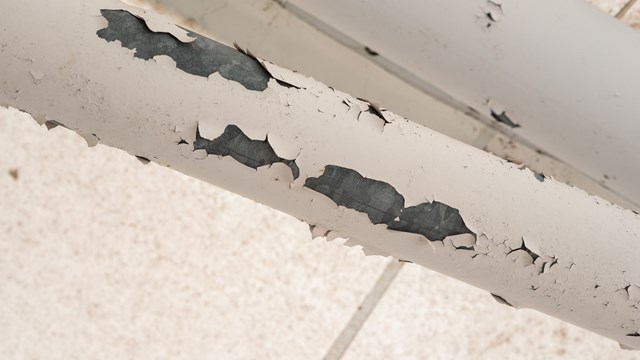
Believe it or not, in addition to disease, bird droppings can also cause surface and even structural damage to buildings and other property. According to the pros, droppings contain uric acid and ammonia, which eat away at building materials, causing corrosion and deterioration. As time goes on, this damage can compromise roofs, erode facades and siding, break down painted surfaces, and cause further damage by clogging drain pipes, vents, and external HVAC equipment, leading to costly mitigation and maintenance.
“The acid in droppings causes damage to metal,” says Gil Bloom, entomologist and president of Standard Pest Management based in Queens. “It will even shut down a distribution system” by corroding pipes and other infrastructure.
Assured Environments concurs, adding that “droppings can severely degrade a steel building’s components and cause substantial structural damage. If an infestation is not removed in a timely manner, the corrosive droppings will not only dissolve building material, but they will encourage fungal growth in the soil, leading to diseased grass, trees, and landscape plants.”
This all leads to increased cleaning and maintenance costs, not to mention the costs to repair and replace corroded or otherwise damaged mechanisms and structures. The safety, sanitation, and health hazards caused by pigeon droppings can also be a liability risk, leading to accidents and lawsuits, and their feces, nests, and the debris they leave behind are simply not a good look, and can negatively affect property values.
Get the Flock Out
The first step to getting rid of a pigeon infestation is to understand the birds themselves. According to Bloom, pigeons seek out two types of sites; those for nesting, and those for loafing. “An ideal nesting site is one that gives the pigeons a sheltered area to build their nests, raise their families, and have an easily accessible food source. Loafing sites are where they’re just hanging out—they’re not necessarily staying there long-term.”
“Birds are very persistent,” he continues. “If they’re just loafing, it’s easier to chase them away from an area—but if they’re nesting, they’re going to be more determined to get back into that space.” Bloom also notes that the proximity of city buildings makes total pigeon removal nearly impossible. “You get rid of them from one structure and end up relocating them to somebody else,” he says.
That said, there are methods for reducing pigeon problems and making your building less appealing for both loafing and nesting. According to Assured Environments, there are three main options: exclusion, perch removal, and behavioral adjustment.
Exclusion usually takes the form of a netting barrier, and is often recommended because it prevents birds from accessing potential roosting spaces in the first place. The upside of this approach for a residential building or community is that it’s relatively inexpensive, permanent, and humane—it doesn’t hurt the birds; it just makes the property less appealing as a nesting or roosting spot. “Netting is the main method we use to prevent the birds from continuing to land, nest, or loaf,” says Bloom. The downside is that depending on how visible the netting is on the property, it might be an eyesore.
Perch removal involves installing devices such as spikes, traps, or wires to prevent birds from landing on a building or other structural component. While this might not be practical for every nook and cranny of a building, it’s often a good solution for a limited area like a railing or an awning.
Behavioral adjustment uses deterrents like cutouts of fake predators (including owls or cats), lasers, and low-voltage electric shocks to train birds to avoid certain areas. These methods disrupt the areas without physically harming the birds, and the low profile of the equipment makes them attractive to communities concerned about the aesthetics of netting or other more visible deterrents. “Another material we use creates a visual disturbance as birds are trying to land, like reflective strips, mylar tape, and laser lights,” says Bloom.
Building staff can also make small changes to help keep the pigeon population under control at a particular site. According to Bilski, simply ensuring that garbage can lids are secured properly and that trees and plants are trimmed back from your building can help.
Bloom agrees, adding that managers and boards can get residents on board with bird control efforts by reminding them that pigeons are pests—not pets. “Some people think it’s okay to let them stay because they’re cute,” he says, “but then you’re going to have a lot more before you even realize it. The best thing is to not give them a sheltered harborage location.”
Bloom suggests giving residents information sheets on how to discourage pest birds, including not feeding them directly and not leaving open gaps underneath window air conditioning units that might be appealing roosts. It can be an uphill battle; Steve Elbaz, founder and president of Brooklyn-based Esquire Management Corp. notes that “people will put up bird feeders, which can cause rifts among the residents. I have a 320-unit association spread out over six acres in Queens where there have been disagreements between residents over these feeders. Because it's not just birds that they bring in—there are squirrels and mites. So now that's a quarrel we have to contend with.”
Bye-Bye, Birdies
If in-house solutions like branch trimming and Don’t Feed the Pigeons signage doesn’t solve the problem, it may be time to call in a professional. According to Elbaz, “There are companies that can install spikes on window ledges and sills, roof lines, overhangs, things like that. And they've been extremely effective. Once you put them in, the birds go elsewhere.”
Other property managers have had a harder time. According to one pro in Manhattan, “First, we used netting to rope off areas to which birds were routinely returning. But that's not entirely helpful, as the birds got very violent trying to fight their way through the net, at which point they needed to be caught humanely and relocated to another area, and the netting needed to be repaired. We kept getting calls from residents saying that they saw another bird, or that they found another hole. Once you have a problem, it's non-stop.”
The manager adds that his firm contracted a no-kill pest control company to repel the invaders, ”But these firms cost quite a bit of money," he says. "It's not $500. It can be as much as $7,000 or $8,000 to take care of something like this. And you have to deal with it.”
And the higher and less accessible the location, the higher the price tag. As Bloom explains, “We’ve used 60-80 foot booms to get to bird locations, and when you get to those heights, you have to get permits. You may even have to close parts of the street, and it takes a long time between setup and take down of equipment.” It all has to get done in a timely way because, depending on the location, leaving equipment up could be dangerous or get in the way.”
And unfortunately, addressing the issue at one building often creates a new issue for its neighbors, as an evicted flock can just relocate next door. “Sometimes there’s construction, or a property will be doing bird exclusion,” says Bloom, “and the birds have to go someplace, right? There’s an endless number of places they can go in cities.”
In the end, when it comes to controlling your building’s share of NYC’s pigeon megaflock, there’s likely not a catch-all solution. Birds and buildings go together like bees and...well, birds, and the best approach to minimizing their negative effects on your property and residents is a diversified one of vigilant maintenance, deterrence, and cooperation between residents and building staff.
Kate Mattiace is associate editor of CooperatorNews.





Comments
Leave a Comment