


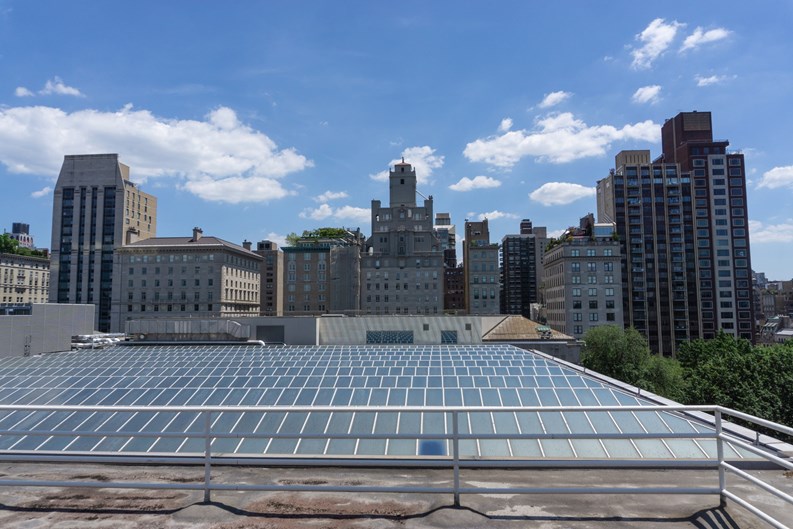
With the clamor and confusion around compliance with Local Law 97 (LL97) requirements, co-op and condo communities across the city are seeking innovative ways to solve their compliance issues. One novel approach is to consider a distributed energy resource developer, or DER.
What is a DER?
In short, a distributed energy resource developer builds, finances, installs, and operates localized energy systems that supply the larger power grid. Those systems can be rooftop solar arrays or battery storage units that feed clean electricity directly into the grid—but unlike traditional power plants often located hundreds of miles away, DERs build and own real, tangible solar power systems distributed across city rooftops.
“Local power generation is key to providing a more stable grid and provides more affordable electricity to consumers,” says Adam Zucker, co-founder of Fieldston Power, a distributed energy company based in New York City. “Distributed energy companies generate actual clean energy, rather than simply trading renewable energy credits. Con Edison is not a power producer—it just distributes and delivers the power.”
Translating DERs to Dense Urban Areas
For obvious reasons, larger scale energy projects like solar panels or wind farms have historically been developed outside of urban areas, where the land is cheaper and more plentiful, and the development process is simply easier. “In New York City,” explains Zucker, “we don’t have traditional acres of land, but we do have acreage that can be assembled across our city’s existing rooftops. Our latest portfolio was constructed across dozens of apartment buildings, which in the aggregate is the equivalent to nearly 14 acres. Aside from using our rooftops, this approach also serves to address the city’s climate mandate. Buildings here contribute 68% of all greenhouse gas emissions, and renewable electricity generated on the roof directly offsets electricity and oil consumption underneath. In short, the infrastructure is already there – it just needs to be modernized.”
Distributed energy resource developers unlock underutilized building space, roofs, electric rooms, courtyards, rear lots and adjacent parcels, and transform them into revenue-generating clean energy assets. By investing their own capital to aggregate multiple individual building projects, DERs are effectively building a ‘virtual power plant’ layered directly on top of a vast network of buildings.
How Does it Work?
Distributed energy resource firms are not vendors—they’re commercial tenants that lease the space on your roof or in your building, Zucker explains. “In return for a long-term lease, shared interest communities receive a brand-new roof membrane with a 20-year warranty, installed prior to the solar deployment, entirely on the DER’s dime and maintained by them for the duration of the lease. Any issues with the roof for the next 20 years, we as a tenant are obligated to address it—and regardless, the warranty rests with the building. We also help co-ops and condos secure a solar real estate tax abatement, which can reach up to $250,000 per building over a four-year period, and enroll our buildings into our community solar system, which lowers the common area electricity. We can also enroll any eligible low-income owner into the program for additional savings. Importantly, our solar production offsets the buildings’ LL97 fine, and we give communities the option to purchase the energy systems under preferable terms after seven years.”
Local Law 97 & DERs
Local Law 97 plays a central role in this scenario. The law imposes strict greenhouse gas emission limits on buildings larger than 25,000 square feet—incluing co-ops and condos—and imposes severe penalties on those who fail to meet these mandates.
Properties best suited for this are those with flat rooftops of 7,000 square feet or larger, ideally with minimal obstructions like mechanical equipment or amenity spaces. Older properties needing roof work can see enormous value, but even roofs recently replaced can benefit meaningfully.
“Hosting a DER system allows buildings to offset their emissions 1:1; in essence, the fine which calculates each kWH consumed inside the building is offset by each kWH produced on the roof,” says Zucker. Installing these systems offers building owners a clear path to reducing their greenhouse gas emissions footprint and their LL97 fine.”




Leave a Comment