


Running along the river on Manhattan’s far west side, overlapping with Hell’s Kitchen to the north and Chelsea to the south, the Hudson Yards used to be a gritty industrial no-man's land of warehouses, parking garages, and the occasional nightclub or artist’s studio dotting the blocks surrounding the hulking Jacob K. Javits Convention Center on 37th Street and 11th Avenue. Bounded roughly by West 30th Street to the south, West 41st/43rd Streets to the north, and Eighth Avenue to the east, the area took its name from the open-air rail yards between 10th and 12th Avenues used by the MTA for storing and maintaining Long Island Rail Road (LIRR) cars.
For decades, the Yards was one of the few remaining slivers of relatively undeveloped land in Manhattan—but all that changed in 2005, when the neighborhood was rezoned in anticipation of NYC’s bid to host the 2012 Olympics. London got the Games, but the rezoning paved the way for what has become the largest private real estate project in U.S. history.
Ground broke on the Hudson Yards redevelopment in 2012, kicking off a decade of construction that shifted Midtown’s center of gravity away from Times Square and toward the river. The $25 billion partnership was a joint venture between Related Companies and Oxford Properties Group, supported by the MTA and Mitsui Fudosan. Financed by Goldman Sachs and Wells Fargo, the project transformed leased air rights over the active rail yards into a city-within-a-city, attracting megacorporations like Meta and Amazon, which quickly leased thousands of square feet of office space in the new commercial towers going up in the West Thirties.
A Tiered Market
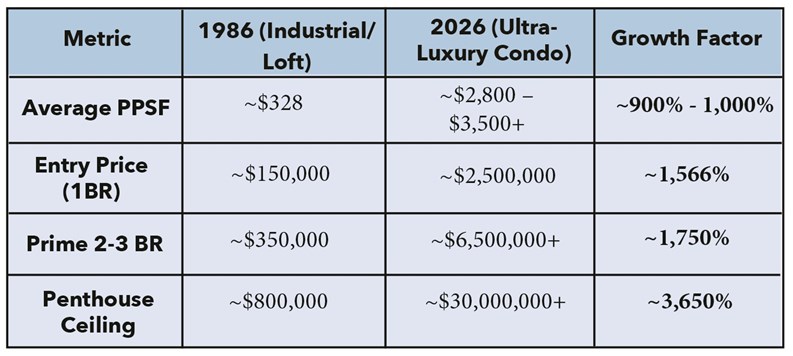
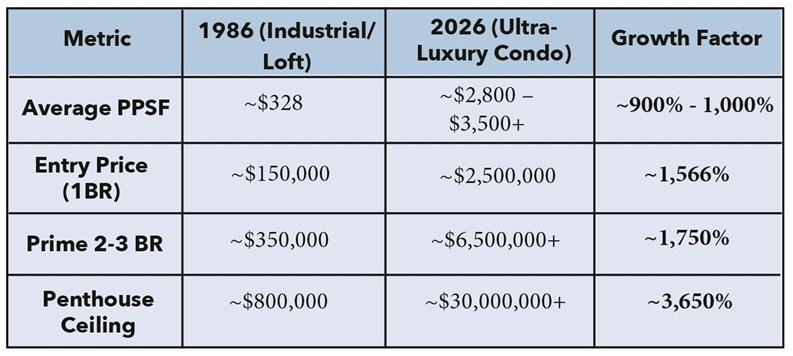
Historically, the housing stock in Hell’s Kitchen was dominated by pre-war walk-ups and mid-century tenements, and the neighborhood surrounding the Hudson Yards area remains a mix of modest co-ops and sleek new rentals. Over the last 30 years however, co-op and condo values have surged from roughly $300 per square foot in the mid-‘90s to an average of $1,600-$2,000 per square foot today.
Current asking prices reflect this tiered market. In the broader Hell's Kitchen area, studios typically range from $500,000 to $750,000, while one-bedrooms land between $850,000 and $1.3 million. Two-bedrooms often start around $1.6 million, climbing significantly higher for new construction.
Once you cross into the Hudson Yards district proper however, the floor shifts dramatically. Two-bedroom condos frequently start at $4 million, and larger three-to-four-bedroom residences average between $7 million and $15 million, with penthouses scaling toward $30 million.
A Tale of Two Towers
Among the neighborhood’s notable residential buildings are the Tailor and the Limestone towers at 15 and 35 Hudson Yards, respectively.
The Tailor was the first residential building to open in the redevelopment zone, and contains 285 market rate condo units and 106 subsidized rental units. Amenities include a 3,500 square-foot fitness center, full-service spa, private dining suites, a wine tasting room, and state-of-the-art private screening theater. The Tailor also boasts the Skytop, an open-air lounge with outdoor kitchens and fireside seating screened by 60-foot tall glass walls to block the wind while providing 360-degree views.
The Limestone is the Tailor’s taller, more exclusive sister tower. The top floors (53 through 92) of the mixed-use building consist of 143 large condo residences, while the lower floors house the luxury Equinox Hotel. The building also contains a 60,000 square-foot Equinox fitness club, to which residents have full access, as well as indoor and outdoor pools, meditation studios, and an on-site restaurant that offers in-residence dining, all managed by a 24-hour concierge.
The Hudson Yards mega-project drove real estate pricing upward all along the Far West Side, introducing a super-prime tier of glass-and-steel condos that has pushed the luxury threshold to unprecedented heights. The area’s redevelopment has compressed the submarket, causing a spillover effect into Chelsea and Hell’s Kitchen, where many boards of older co-ops are considering investing in major capital improvements just to remain competitive with the ultra-modern amenities on the river.



Leave a Comment