


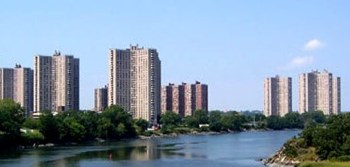
Sprawling across 320 acres in the northeast corner of the Bronx, Co-op City houses over 43,000 residents across 15,372 residential co-op units, making it the largest housing cooperative in the world. Beyond its staggering scale, Co-op City represents a unique socio-economic experiment in maintaining permanently affordable, working-class housing in a city notorious for sky-high housing costs.
History & Development
Prior to its mid-century transformation, the marshy ground beneath Co-op City was occupied by Freedomland U.S.A., a short-lived American history-themed amusement park that operated from 1960 to 1964. Following the park's bankruptcy, the United Housing Foundation (UHF) stepped in to spearhead a master-planned residential community.
The core impetus for developing Co-op City was to keep working-and-middle-class families from abandoning New York City for the suburbs. By the mid-1960s, the Bronx was facing rapid economic shifts, deteriorating tenement housing, and urban decline. The goal of Co-op City’s developers was to create an affordable, high-quality, suburban-style alternative within the city limits where families could afford to stay.
Key players behind the project included the United Housing Foundation (UHF), a powerful federation of housing cooperatives and labor unions. Led by cooperative housing advocate Abraham Kazan, the group championed the idea of Co-op City as a self-contained cooperative utopia that could be a model of how to solve the city’s perpetual housing shortage.
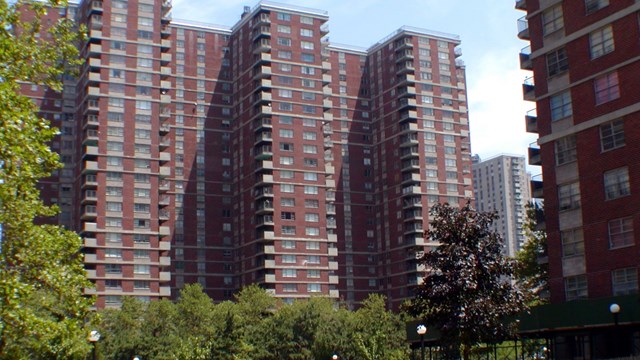
Also instrumental in the project was Herman Jessor, chief architect of the complex. A devotee of the modernist “Tower in the Park” philosophy, he designed the massive footprint of 35 high-rises and seven townhouse clusters to maximize green space, natural light, and fresh air.
Providing the project’s financial engine was the State of New York’s Mitchell-Lama program, a post-war legislative initiative designed to boost affordable housing through state-financed, low-interest mortgages and sweeping tax subsidies. Through the program, the state supplied the low-interest mortgages and massive tax exemptions that allowed the UHF to build at such an unprecedented scale while keeping buy-in costs low for residents.
Building the Future
Physical construction on Co-op City began in 1966, and challenges arose immediately. Building massive brick towers atop loose landfill overlying a swamp required complex engineering that led to severe cost overruns. The initial $235 million mortgage ballooned to $390 million by the time construction concluded in 1973, exacerbated by 1970s inflation and rising interest rates. This debt load triggered skyrocketing maintenance fees for the first wave of residents, culminating in 1975 when a historic, 13-month fee strike ultimately forced the state to hand over management of the complex to the resident-run Riverbay Corporation.
Demographics & Evolution
In its earliest years, the Co-op City community was heavily populated by upwardly mobile, working-class Jewish families migrating from other parts of the Bronx, many of whom were union members tied to the UHF. Over the ensuing decades however, the complex’s population evolved to mirror the broader demographic shifts of New York City.
By the turn of the 21st century, Co-op City had transitioned into a vibrant community composed predominantly of African American and Hispanic residents. Modern census data highlights a population that is roughly 59% Black and 29% Hispanic, serving as a stable hub for New York City's minority middle class, including a high concentration of civil servants, transit workers, teachers, and nurses. The neighborhood has also evolved into a Naturally Occurring Retirement Community (NORC), with a significant population of legacy seniors aging in place, supported by local social services heavily tailored to their needs.
Holding the Line
Like in any residential cooperative, Co-op City residents do not own their apartments as traditional real property; instead, they own shares in the Riverbay Corporation corresponding to the size of their apartment. Because Co-op City operates under strict Mitchell-Lama guidelines, buyers do not pay open-market prices, but instead purchase equity shares ranging from roughly $30,000 to $50,000 upfront depending on the size of the unit. Once moved in, capped monthly maintenance fees—including all utilities—generally hover between $1,200 and $1,800.
However, because of those same strict Mitchell-Lama guidelines, equity growth in Co-op City is also legally capped to keep the community permanently affordable. That means that when a resident leaves, rather than flipping the unit to the highest bidder on the open market, they must sell their shares back to the corporation at a predetermined, formula-based price based on their initial investment. This keeps the buy-in costs remarkably low.
Though the state has spent hundreds of millions of dollars over the decades to repair structural defects stemming from the original marshland foundations, Co-op City remains a highly resilient economic fortress that has helped thousands of working-class families survive the hyper-inflationary real estate cycles that dominate the rest of New York City.




Leave a Comment